How to Start a Septic Pumping Business in 2026: A Complete Operator’s Guide
If you’re reading this, you’ve probably noticed something about the septic industry: there’s a lot of demand, the work isn’t going anywhere, and the operators who own their routes tend to do well. Maybe you’ve been driving for somebody else and you’re tired of building their company. Maybe a retiring operator is selling a route and you’re trying to figure out if it’s a real opportunity or a money pit. Either way, starting a septic pumping business is one of those moves that looks deceptively simple from the outside and gets complicated fast once you start pricing it out.
This guide walks you through the decisions that actually matter – licensing, equipment, disposal, pricing, insurance, software, and your first customers. We’ll skip the generic small-business advice (“write a business plan!”) and focus on what’s specific to running a septic operation.
A quick note on the market
According to the U.S. EPA, more than one in five U.S. households – roughly 21.7 million homes serving over 60 million people – depend on individual onsite or small community septic systems. About one-third of all new residential development is served by septic or other decentralized systems. State-by-state penetration varies wildly: roughly 55% of homes in Vermont versus about 10% in California, with New England and the Southeast having the highest concentrations. Wherever you’re starting a septic pumping business, the customer base is real – these tanks need pumping every 3-5 years on a typical residential schedule, and most of them aren’t going on city sewer anytime soon.
What you’re actually getting into
Septic pumping is a service business with a heavy capital component. You’ll spend most of your time driving, pumping, and dealing with customers. You’ll spend a smaller but critical amount of time on dispatching, billing, manifests, and figuring out where to dump.
The economics, ballpark:
- Average residential pump-out: roughly $290-$650 nationally for a standard 1,000-1,500 gallon tank, with the typical homeowner paying around $425, per Angi and HomeAdvisor 2026 data. Smaller tanks on easy-access properties land at the low end; larger or hard-to-reach systems push higher. Regional spread is significant – homeowners in parts of the Southeast pay closer to $250 while parts of the Northeast and Hawaii routinely run $700+.
- Disposal fees: highly regional. Public rate sheets show Winston-Salem NC at $0.024/gallon for domestic septage; the US Virgin Islands is implementing $0.076/gallon as of January 2026; Texas TCEQ assesses a separate surface-disposal fee of $1.25 per dry ton on top of any plant gate fee. Get a real number from your local plant before you build a route.
- Truck capacity: most residential operators run 2,000-4,000 gallon vacuum trucks; commercial operators often run 4,000-5,000+ gallons (per Satellite Industries).
- Jobs per day per truck: highly variable depending on route density, drive time to disposal, and average tank size. The single biggest profitability lever in this business.
The biggest variable in your P&L isn’t pricing – it’s route density. A truck that drives 15 minutes between jobs makes a lot more money than one that drives 45 minutes between jobs. Everything you build should be aimed at packing your routes.
Before you go further, ask yourself this honestly: are you willing to be the person who shows up to deal with a backed-up tank on a Saturday in July? Because that’s the job. The operators who succeed are the ones who treat customer service as the actual product. Pumping out a tank is the easy part.
Step 1: Licensing and permits
A septic pumping business is regulated at multiple levels. Federally, EPA’s 40 CFR Part 503 governs how domestic septage is land-applied or otherwise disposed of, and sets recordkeeping and certification requirements for haulers who land-apply (the EPA also publishes a plain-English guide to the Part 503 rule). States layer on additional rules – most require a state-issued pumper or hauler license through the environmental or health agency, and many counties add their own permits on top.
At the federal level, you’ll also typically need:
- DOT registration for any commercial vehicle
- A CDL Class B for the operator (most vacuum trucks exceed the 26,001 lb GVWR threshold that triggers the requirement)
- Annual truck inspections
- Proof of liability insurance and workers’ comp
The single most important thing you can do here is call your state’s environmental health office and ask: “What does someone need to do to legally pump septic tanks in this state?” Write down what they tell you. Then call your county health department and ask the same thing – local rules often layer on top of state rules, and the county is usually who shows up if there’s a complaint.
For technical training, the National Association of Wastewater Technicians (NAWT) offers a Vacuum Truck Technician certification course that’s recognized nationally and is a sensible credential to pursue once you’re up and running. NAWT also offers DOT CDL Pre/Post Trip Inspection training, inspector certification, and installer training. In a few states, NAWT certifications align with state licensure requirements; in others they’re voluntary but useful for credibility.
We’re publishing state-by-state requirements as a separate series. Check the state directory for your specific situation.
Step 2: The truck
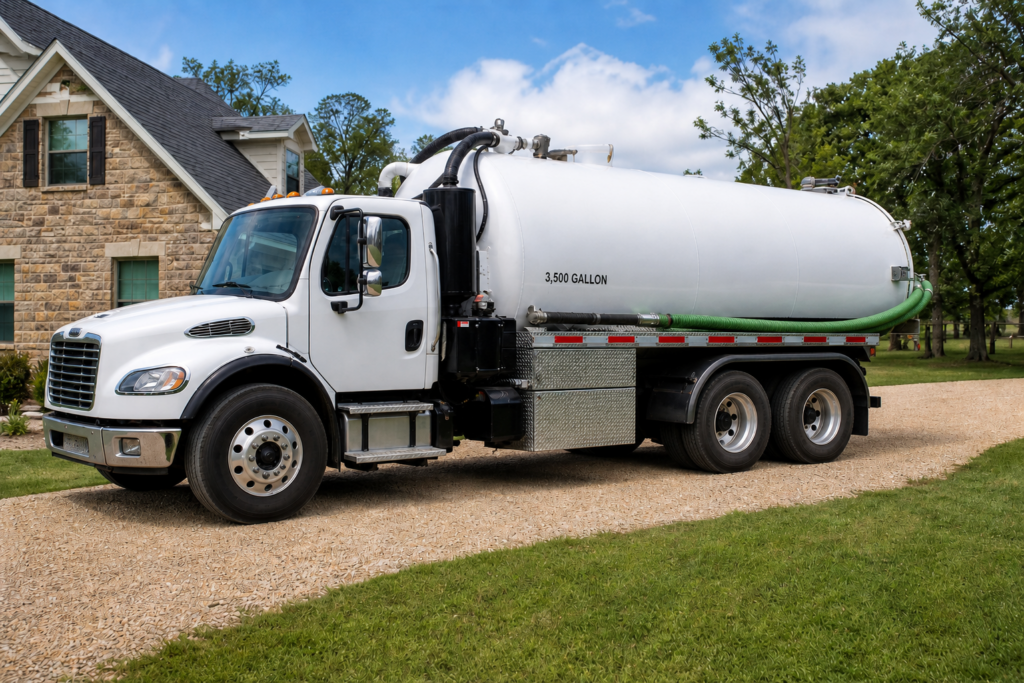
Your truck is your most important and most expensive purchase. Four decision points:
Tank capacity. A 2,000-gallon tank gets you started. 3,000-4,000 is the residential sweet spot for most operators. 4,000+ makes sense for commercial routes or when you’re driving long distances to disposal. Bigger isn’t always better – bigger trucks cost more to operate, may require tandem axles to stay legal on weight, and can struggle to fit on tight residential properties. Note that smaller “non-CDL” units (typically 2,000-2,500 gallon tanks on Class 6 chassis with GVWR under 26,001 lbs) are also widely available if you want to operate without a CDL initially, as KeeVac Industries and other builders detail.
New vs. used. As of 2026, used septic trucks typically run $40,000-$120,000 depending on age, condition, and capacity. New trucks built out for the work generally run $140,000-$300,000+, with most fully-equipped builds landing in the $150,000-$250,000 band, per Iron-Vac Trucks and Satellite Industries pricing data. For a first truck in a new septic pumping business, used is almost always the right call – the operating economics are similar, financing is easier, and you don’t tie up cash in depreciation while your route is still building.
The pump. Vacuum pumps from established manufacturers – Masport, NVE, Chandler, Fruitland, Battioni, and Jurop – are what most professional builders use. They’re serviceable in most regions and parts are available. Avoid orphan brands you can’t get parts for. Being down for two weeks waiting on a pump rebuild kills cash flow.
Financing. SBA 7(a) loans are widely used for equipment-heavy startups. As of April 2026, with prime at 6.75%, maximum SBA 7(a) variable rates run roughly 9.75%-13.25% depending on loan size. Equipment finance companies will lend on used trucks but typically require 10-20% down and run higher than SBA rates.
We have a more detailed truck buying guide if you want to go deeper on this decision.
Step 3: Where you’re going to dump
This is the step new operators most often underestimate. You can’t just dump septic waste anywhere – it’s regulated waste and you need a permitted facility willing to accept it. Your options usually include:
- Municipal wastewater treatment plants (POTWs). Most accept domestic septage but charge per gallon and often require a hauler permit, contract, or pre-approval. Hours and capacity vary by plant. Many states (including New Hampshire by statute) require every municipality to provide some way to safely dispose of septage either through local treatment or written agreement with another receiving facility.
- Private septage receiving facilities. Less common, but they exist in some regions and can be more flexible on hours.
- Land application sites. EPA Part 503 allows land application of domestic septage at agricultural land, forests, and reclamation sites under specific pathogen reduction, vector attraction reduction, and recordkeeping requirements. Many states impose stricter rules on top of the federal floor.
The EPA’s Guide to Septage Treatment and Disposal (EPA 832-B-92-005) is the federal reference document on receiving stations, manifest tracking, and treatment options – worth bookmarking.
Before you buy a truck, identify two or three disposal sites you can actually use. Get pricing in writing. Know their hours. Confirm they’ll accept your waste type – and note that many municipal plants won’t accept loads contaminated with grease trap waste, which has separate disposal requirements and is treated as commercial septage rather than domestic. A common rookie mistake: building a route 90 minutes from your only disposal site, then realizing every load eats two hours of windshield time. The route looks great on paper and bleeds money in practice.
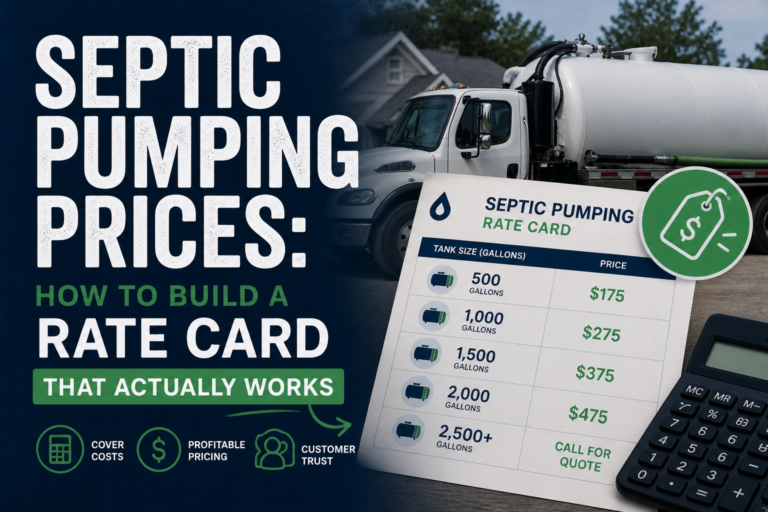
Step 4: Pricing your services
The biggest mistake new operators make is pricing based on what competitors charge instead of what their costs require. Build your pricing from the bottom up:
- Direct labor (your time at a real hourly rate, including drive time)
- Disposal fees per gallon
- Fuel
- Truck maintenance and depreciation
- Insurance allocated per job
- Overhead – software, phone, accounting, the boring stuff
Then add your margin. The right margin target depends on your market, but if your math doesn’t get you to a healthy gross margin at the prices customers will actually pay, either the market won’t support a new septic pumping business or your route density needs to improve before you commit.
We have a deeper pricing post that walks through the math with example numbers.
Step 5: Insurance and bonding
You’ll need:
- General liability – covers third-party bodily injury and property damage from your operations. Septic contractors typically pay roughly $800-$3,500/year for general liability depending on revenue and crew size.
- Commercial auto on the truck.
- Workers’ comp – required in nearly every state once you hire anyone (and in some states, even for sole proprietors).
- Environmental/pollution liability – this is the one new operators often skip. Don’t.
Pollution liability matters because if you spill on a customer’s property or contaminate a well, your general liability policy probably won’t cover it – most GL forms specifically exclude pollution claims, which is exactly the risk septic work creates. Insureon’s small business customers pay a median of about $223/month – roughly $2,675/year – for environmental liability coverage. Specialized septic-industry programs like WaterColor Management are widely available and often more cost-effective than generic environmental policies.
Some states or commercial customers also require a surety bond. Check before you bid on commercial contracts – getting a bond after you’ve already committed is stressful and sometimes expensive.
Step 6: Your software stack
The right software stack for a one-truck septic pumping business is different from what you’ll need at five trucks. For your first six months, you need:
- Scheduling and dispatch
- Invoicing with credit card processing
- Manifest tracking (required by most states)
- A basic customer database
You don’t need enterprise field service software on day one, but you also don’t want to be running on spreadsheets and a paper calendar when you grow into a real customer base. The transition is painful, and customers fall through the cracks during it.
The bigger point: pick software built for septic, not a generic field service tool that wasn’t designed with manifest tracking, gallon-level billing, or disposal site logic. Tank Track is our platform – purpose-built for septic, grease, and portable sanitation operators – but the principle is true regardless of which tool you choose. Generic field service software will fight you on the things that are unique to this work.
We have a buying guide that walks through the major options.
Step 7: Getting your first customers
The fastest paths to your first 50 customers, in rough order of what actually works:
- Acquire a small route. If a retiring operator is selling, this is the highest-leverage move available. You’re buying customer relationships, route density, and disposal-site access all at once. Pricing varies widely; a route’s value depends heavily on customer quality, density, and contract structure.
- Realtors and home inspectors. These are the people who refer pre-sale septic inspections, which often turn into pump-outs. Build five real relationships and your phone will ring.
- Google Business Profile and reviews. Set this up on day one. Ask every customer for a review at the end of every job. The operators ranking on local search are the ones with strong review counts and high ratings. There’s no shortcut.
- Direct mail to neighborhoods with septic systems. Better than people expect. The ANA/DMA 2025 Response Rate Report puts the average direct mail response rate at 4.4% across industries, with local small businesses around 3% – far higher than email (~0.12%) or paid social. Target homes on septic using your county tax assessor data and you’ll likely beat those benchmarks because the offer is highly relevant.
- Yard signs and truck wraps. A magnetic sign on the truck and a yard sign at every job (with the customer’s permission) builds local awareness for almost no money.
What doesn’t work as well as people expect: paid Google ads in the first few months (expensive and competitive against established operators), Facebook ads (low intent), and pure SEO plays (slow to pay off).
Step 8: When to hire your first driver
The math on hiring your first driver in a septic pumping business isn’t about whether you can afford one driver – it’s about whether you can keep two trucks busy. Per the U.S. Bureau of Labor Statistics, the median annual wage for heavy and tractor-trailer truck drivers – the SOC code that covers vacuum truck operators – was $57,440 in May 2024, with the bottom 10% earning under $38,640 and the top 10% earning over $78,800. Once you load in employer-side payroll taxes, workers’ comp, and any benefits, expect a fully loaded cost of roughly $70,000-$95,000 for a single driver, depending heavily on workers’ comp rates in your state.
The trap most owner-operators fall into is hiring before they have the route density to keep two trucks full. The result: you’re working harder and less profitable than when it was just you. Don’t hire until you’re consistently turning down work or pushing it more than a week out.
When you do hire, hire someone with a CDL who can pass a drug test and has a clean driving record. Pay above market – drivers who feel underpaid will leave for the competitor down the street, and recruiting a replacement takes weeks you don’t have.
We have a hiring post with a job description template you can adapt.
Common mistakes that sink new septic pumping businesses
After watching operators start up over the years, the recurring mistakes are pretty consistent:
- Buying too much truck. A loaded $250,000 new truck will eat your cash flow before your route is mature. Start used. Upgrade later.
- Underpricing to win business. Pricing well under market gets you the customers nobody else wants – slow payers, complainers, and emergency-only callers. Hard pass.
- Skipping pollution liability. One spill and your business is over.
- Not tracking manifests properly. EPA Part 503 and state-level rules carry real recordkeeping and certification obligations for land-applied septage; municipal plant manifests have their own retention rules. Enforcement is uneven but the penalties when it catches up to you are not small.
- Trying to grow on spreadsheets. Manual systems start failing as the customer base grows. Customers get missed. Invoices don’t go out. Revenue leaks.
- Not asking for reviews. Operators who ask after every job dominate their local search rankings within 12-18 months.
What’s next
If you’re seriously evaluating starting a septic business, the next two posts to read are our pricing guide and our truck buying guide. Together they cover most of the financial decisions you’ll need to make before committing money.
If you already have a route and you’re trying to operate it more efficiently, take a look at our post on route optimization.
For ongoing industry news and equipment reviews, Pumper Magazine is the trade publication most operators read. For technical training and certification, look at NAWT and your state’s onsite wastewater association.
Frequently asked questions
How much does it cost to start a septic pumping business? The truck is the largest single line item – roughly $40,000-$120,000 used or $150,000-$300,000+ new in 2026, depending on chassis, tank size, and pump. Add insurance setup, software, licensing, and operating reserve, and a realistic minimum starting with a used truck is in the low six figures.
Do I need a CDL to drive a septic truck? In most cases, yes. A CDL Class B is federally required to operate any single vehicle with a GVWR of 26,001 pounds or more. Most professional vacuum trucks exceed that threshold. Some smaller “non-CDL” units (typically 2,000-2,500 gallon tanks on Class 6 chassis) do exist on the market and can be operated without a CDL – check the specific GVWR before assuming.
How long until a new septic operation is profitable? Highly variable. Operators who acquire an existing route are often profitable from day one. Operators starting cold typically need 6-18 months to build enough route density to cover fixed costs.
Can I start a septic business part-time? Technically yes, but you’ll struggle. Customers expect responsive service, especially for emergency calls. Part-time operators tend to lose customers to full-time competitors who answer the phone on Saturday.
What’s the biggest factor in whether a septic business succeeds? Route density. The single best predictor of profitability isn’t pricing or efficiency – it’s how tightly packed your customer base is geographically. Build your route first; everything else gets easier when the routing math is in your favor.
Tank Track is field service software built specifically for septic, grease, and portable sanitation operators. If you’re starting up and want to talk through your software stack, [request a demo].