Septic Pumping Prices: How to Build a Rate Card That Actually Works
There are two ways to set septic pumping prices. The first is to call three competitors, ask what they charge, and price 5% under the cheapest. The second is to build your rate card from your actual cost structure and then test the market against it. The first method is faster and almost always wrong. This post walks through the second method – the one that keeps your business profitable when fuel costs jump 30% in a year, when a driver quits, or when your disposal site raises its gate fee on 30 days’ notice.
If you’re new to the industry, our guide to starting a septic pumping business covers the broader picture. This post zooms in on one of the highest-leverage decisions you make: what you charge.
What homeowners actually pay (and what that tells operators)
Before you set your prices, look at what the market is paying. According to recent 2026 cost data, the national average septic tank pumping cost lands around $425, with most homeowners paying between $290 and $650 for a standard residential pump-out. HomeGuide’s data suggests an average of around $375 with a typical range of $295 to $610.
Regional spread is significant. Pricing is consistently lower in the Southeast (rural Georgia at $275-$450, lower labor and year-round service availability) and higher in the Northeast and select metros (Long Island and Boston suburbs commonly running $600+, parts of Hawaii routinely above $700). Tank size matters: a standard 1,000-gallon tank typically costs $350-$425, while a 1,500-gallon tank runs $400-$550.
For an operator setting septic pumping prices, that consumer data tells you the ceiling and the floor. It does not tell you what to charge. What you charge has to come from your costs.
The seven cost components every rate must cover
Every septic pumping price you set has to cover seven things, plus margin:
1. Direct labor. Your time on the job, valued at a real hourly rate (not zero – even if you’re the owner-operator, your time has opportunity cost). Plus drive time to and from the job, plus drive time to disposal.
2. Disposal fees. Per-gallon fees at your receiving facility. As established in our guide to starting a septic business, these range from 2-3 cents per gallon at low-cost municipal plants to 7-10+ cents at constrained or remote facilities. A 1,000-gallon tank hauled to a 5-cent plant means $50 in disposal cost alone.
3. Fuel. As of late April 2026, on-highway diesel averages $5.35 per gallon nationally, and the EIA’s Short-Term Energy Outlook projects $4.80/gallon as the 2026 annual average. At 8 MPG and a 25-mile round trip per job, that’s about $17 in fuel per stop.
4. Truck costs (depreciation or loan + maintenance reserve). A truck that runs 50,000 miles per year and lasts 10 years before major rebuild needs to recover its purchase cost across that lifetime. For a $120,000 used truck, that’s $12,000/year just in capital recovery, plus a maintenance reserve. Industry rule of thumb: $0.20-$0.30 per mile in maintenance reserve for heavy service vehicles.
5. Insurance. General liability ($800-$3,500/year per Life143’s septic contractor data), commercial auto, workers’ comp, and environmental/pollution liability (Insureon’s median is around $2,675/year for environmental coverage). Allocate per-job by dividing total annual insurance cost by jobs per year.
6. Overhead. Software, phone, accounting, marketing, office. Allocate per-job similarly.
7. Margin. What’s left after all of the above is what funds your growth, your bad weeks, your tax bill, and your ability to take a vacation.
If your septic pumping prices don’t cover all seven, you’re slowly liquidating your business and calling it revenue.
Building your rate card from the bottom up
Here’s a worked example for a one-truck operator running a 3,500-gallon vacuum truck in a typical residential market:
Per-job costs (1,000-gallon residential tank, 25-mile round trip, hauled to municipal plant at $0.05/gallon):
- Labor: 90 minutes at $50/hour fully loaded = $75
- Disposal: 1,000 gallons × $0.05 = $50
- Fuel: 25 miles ÷ 8 MPG × $5.35 = $17
- Truck capital recovery: 25 miles × $0.40/mile (depreciation + maintenance reserve) = $10
- Insurance allocation: $8,000/year ÷ 1,500 jobs = $5
- Overhead: $20,000/year ÷ 1,500 jobs = $13
Total cost per job: $170.
For a 30% gross margin, your septic pumping prices for this base service need to be roughly $243. For a 40% margin, $283. Operators who can hit 50%+ gross margin do so with strong route density (more jobs per mile), volume discounts on disposal, and pricing power that comes from local reputation.
A few sanity checks against this number:
- It should be below the homeowner price range in your region. If your cost-based number ($243-$283) is above what local homeowners are paying ($300-$450), you have margin headroom. That’s good.
- It should be above your disposal cost plus fuel. If you’re at or near that floor, you’re operating at a loss.
- It should account for tank size. A 1,500-gallon tank costs you ~$25 more in disposal than a 1,000-gallon. Your rate card should reflect that.
Building the actual rate card
A simple, defensible rate card structure:
Standard scheduled pumping:
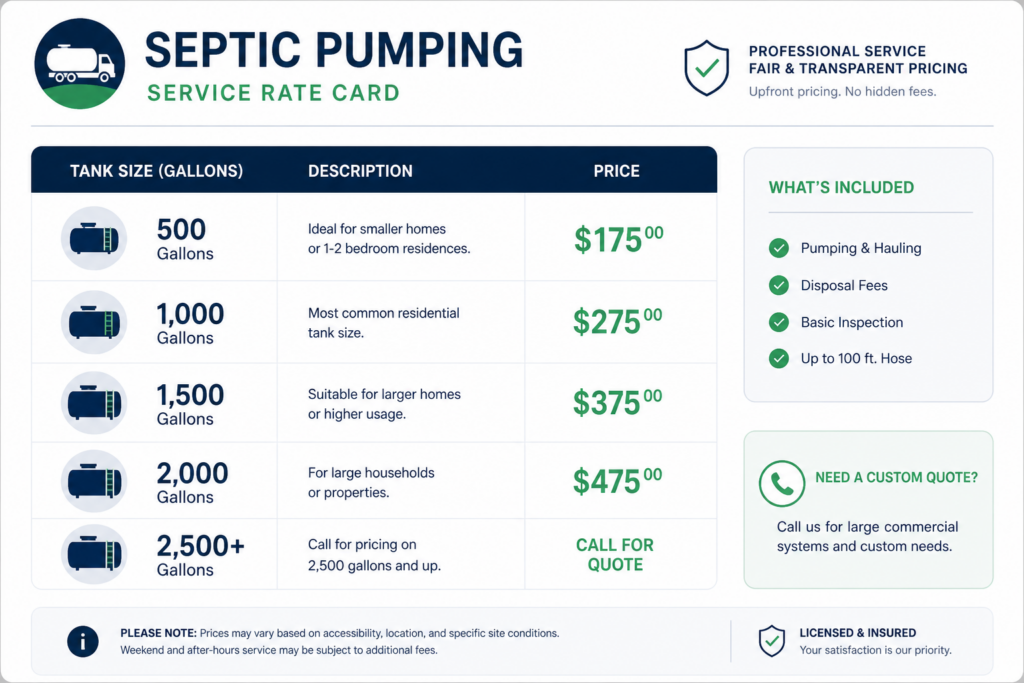
- Up to 1,000 gallons: base price (e.g., $325)
- 1,000-1,500 gallons: base + $50
- 1,500-2,000 gallons: base + $100
- 2,000+ gallons: base + $50 per additional 500 gallons
- Travel surcharge: $X per mile beyond 15 miles from your base
Add-ons:
- Difficult access (riser depth >24″, tank under deck/landscaping): +$50-$100
- Tank locating (no records, no riser): +$75
- Baffle inspection report: +$50
- Pre-existing access risers: $0 (this is a feature, not an add-on – reward customers who installed them)
Emergency / after-hours:
- Same-day emergency (under 4 hours): +50% premium
- Evening (after 5pm): +25%
- Weekend: +25%
- Holiday: +50%
Real estate transactions:
- Pump + visual inspection report: standard pump price + $150-$250
- Full inspection (Title 5 or PSMA/NOF style): $400-$700 depending on state, separate from pumping
The exact dollar values shift based on your market, but the structure should look like this. Customers respect transparent pricing far more than they respect a “we’ll send a quote” approach.
Scheduled vs. emergency pricing – the most important distinction
The single most important thing to get right in your septic pumping prices is the gap between scheduled and emergency work. Emergencies cost you more for real, defensible reasons:
- They displace scheduled work or push it into overtime
- Drivers earn premium pay for after-hours
- You can’t optimize routing – you’re driving directly to one job
- Disposal sites may be closed, forcing you to truck a load home or to a more distant site
- The customer is in distress and the value to them is dramatically higher
A 50% premium on emergency work is industry-standard. Some operators charge 100%. The mistake is charging the same as scheduled work because “I was already nearby.” That trains customers to call you for emergencies and never schedule maintenance.
The same logic applies to weekends and holidays. If you’re going to answer the phone on a Saturday night, charge accordingly. Operators who don’t end up resenting the work and providing worse service.
What to communicate to customers
Pricing transparency wins more business than discounts do. On your website and in your phone scripts, communicate:
- A starting price. “Septic pumping starts at $325 for a standard 1,000-gallon tank, scheduled service.”
- What’s included. “Includes pumping, disposal, and a basic visual inspection of the tank, baffles, and inlet/outlet pipes.”
- What’s extra. “Additional charges may apply for tanks deeper than 24 inches, tank locating if no records exist, or emergency service.”
- Payment terms. “Payment due at time of service. We accept cash, check, and all major cards.”
Customers comparison-shop. Operators who can answer the price question on the first call book significantly more jobs than operators who say “we’ll need to come look first.”
When and how to raise prices
Most septic operators under-raise prices. Costs go up every year – fuel, labor, insurance, disposal fees – and pricing has to keep pace or margins shrink invisibly until you’re suddenly working twice as hard for the same take-home.
A few principles for price increases:
- Annual review, every January. Pull your actual cost structure for the prior year, recalculate your per-job costs, and update your rate card accordingly. If your costs went up 6%, your prices should go up at least 6%.
- Telegraph it to existing customers. A short email or postcard to your customer base 60 days before the increase, explaining briefly that costs are up. Most customers don’t react. The few who do are usually price-shoppers who weren’t going to be loyal anyway.
- Don’t apologize. Communicate the change as a fact, not as a guilty admission. “Effective January 1, 2027, our pumping rate increases from $325 to $345.” Done.
- Grandfather contract customers, sometimes. For your largest commercial accounts on multi-year contracts, honor existing terms. For standard residential, no grandfathering – everyone moves to the new rate.
The hardest pricing conversation isn’t with customers – it’s with yourself. Owner-operators who built their business at $250 per pump-out have a hard time charging $325 even when their costs require it. The customers who push back hardest on $325 are usually customers who weren’t profitable at $250 anyway.
How software fits into pricing
A few specific ways pricing software pays for itself:
Automated price-by-tank-size logic. Your dispatchers shouldn’t be calculating tank surcharges in their head. Software that asks “what size tank?” at booking time and auto-applies the correct rate eliminates a major source of revenue leakage.
Integrated invoicing at time of service. When the driver completes the job, the invoice should generate automatically with the correct line items, tax, and any add-ons. Manual invoicing leaks money through omissions and delays.
Payment processing at the truck. Drivers who can take payment on a tablet at the customer’s house close out 80%+ of jobs same-day. Operators who invoice 30 days later collect at 70-80% on the dollar after dunning. The math on this is staggering at scale.
Tank Track was built for septic, grease, and portable sanitation operators specifically because generic field service software fights you on pump-volume billing, gallon-tier pricing, and disposal-fee passthrough. The pricing engine matters as much as the routing engine.
For an end-to-end view of how pricing flows into your operations, see our [septic business software buying guide].
What’s next
If you’re early in pricing decisions, our guide to starting a septic pumping business covers the broader cost framework. If you’re ready to look at how pricing and routing interact (route density is the single biggest profitability lever after pricing), see our septic route optimization post.
If you’re ready to see how pricing works inside Tank Track, [request a demo].
Frequently asked questions
What are typical septic pumping prices in 2026? The national average lands around $425, with most homeowners paying $290-$650 depending on region, tank size, and access difficulty. Operators should set their rate cards from cost components rather than market average.
How much should I charge for emergency septic pumping? Industry standard is a 50% premium over scheduled rates. Some operators charge 100%. The premium reflects real cost differences (overtime labor, route disruption, after-hours disposal) and the higher value to a customer in distress.
Should I match competitor septic pumping prices? No. Match your cost structure. Competitor pricing tells you the market ceiling and floor. Your costs tell you what you can profitably charge. If your costs require $325 and competitors charge $275, either your costs are too high or theirs are unsustainable.
How often should I raise septic pumping prices? Annually, pegged to actual cost increases (fuel, labor, insurance, disposal). 60 days advance notice to existing customers is standard. Most operators under-raise prices and watch their margins erode quietly.
What’s the typical gross margin for a septic pumping business? Operators with good route density and pricing discipline typically run 30-40% gross margin on pumping work. Higher margins (50%+) are achievable with strong commercial mix, dense routes, and pricing power from local reputation.
Tank Track is field service software built specifically for septic, grease, and portable sanitation operators. If you want to see how pricing, routing, and invoicing work together inside our platform, [request a demo].